
Disruptive innovation in consulting
HOW DOES THE MODEL WORK?
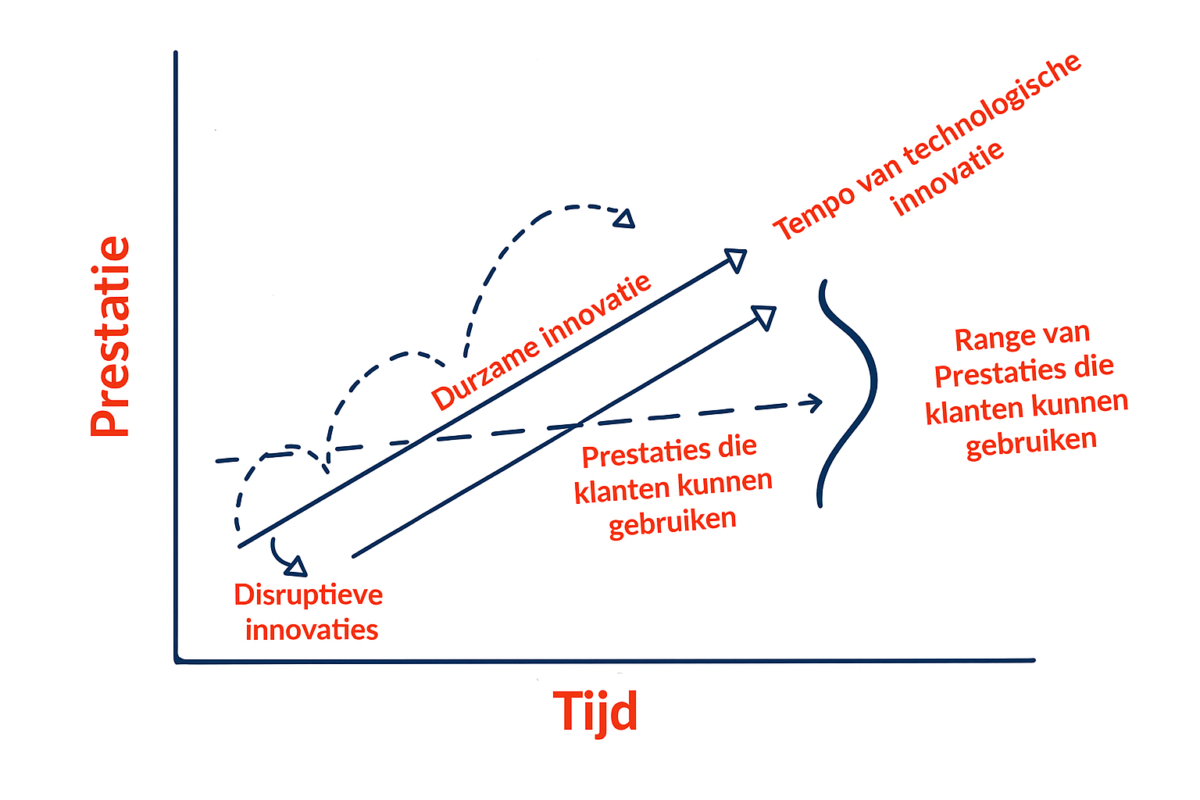
The disruptive innovation model, developed and popularized in 1995 by Clayton Christensen, describes how new players with simpler, cheaper, or more innovative business models can disrupt established markets. Disruption often starts small: with products or services that initially seem "not good enough" for mainstream customers, but eventually grow to become the dominant market standard. Think of Amazon, Uber, and Netflix.
Christensen distinguishes between low-end disruption (targeted attacks on the lower end of the market with overqualified products) and new-market disruption, which appeals to entirely new customer groups. While many companies are aware of the disruptive threat, it proves difficult to be disruptive themselves—often due to rigid structures, customer expectations, or internal interests.
In "Consulting on the Cusp of Disruption" (Harvard Business Review, 2013), Christensen describes how the consulting sector is also becoming susceptible to disruption. New providers combine technology, modularity, and lower costs to take over parts of the work of traditional consultancies. Transparency, digital tools, and the rise of internal strategy units at clients are contributing to this shift.
The model encourages established organizations to reflect on themselves: do they have the right processes, structures, and values to innovate independently? In some cases, a separate business unit or spin-off is necessary for innovation to succeed—separate from existing routines. Those who cling to past successes for too long risk being caught unawares.
FROM THEORY TO PRACTICE:
Interview with Geert Janssen
Why does the disruptive innovation model appeal to you?
Disruption often begins under the radar, with solutions that aren't initially taken seriously. Until they radically change the market. Think of how digital platforms, particularly those using AI, are automating legal processes. I believe that as an advisor, you not only need to understand your profession but also to sense when the rules of the game are changing. Our field is particularly susceptible to innovation, precisely because we work with many structures and interests simultaneously.
How do you see disruption reflected in notarial practice?
Christensen distinguishes between low-end disruption and new-market disruption. I see both. Think, for example, of parties like Juridisch Loket (Legal Desk) or online providers of standard contracts. For certain client groups, these are "good enough." They seem harmless, but they are slowly taking market share from traditional firms. On the other hand, you see new markets emerging. We increasingly support innovative real estate projects, such as sustainable area developments or residential concepts with shared facilities. These involve not only legal but also fiscal, construction, and financial aspects. In such projects, clients don't want a traditional deed factory, but an equal partner. Following Christensen, I believe that organizations that cling to old structures will struggle. Innovation often doesn't "fit" within existing systems. That's why we organize our projects as much as possible in flexible teams, free from traditional silos. Sometimes that seems illogical within the notary profession, but it works.
What can other professional service providers learn from this model?
I recognize the increasing pressure on existing structures that Christensen and his co-authors point to. Consulting and legal services have also long been shielded by opaqueness: clients don't know exactly what you do, so they rely on reputation, network, or price as indicators of quality. But that fog is lifting. Clients are better informed, use benchmarks, work data-driven, and expect speed and transparency. You see this, for example, in how general counsels request and manage their legal services: more detailed, more modular, and based on measurable output.
The answer lies not in panicking, but in consciously reshaping your organization. Christensen calls this "self-disruption." Do you dare to explore a new business model, even if it clashes with your existing practices? Do you dare to give young people responsibility, adjust your pricing model, or standardize your services where possible? We achieve this by operating from multiple hubs in the Randstad, close to the client. We digitize processes and participate in development programs early on.
What is your most important lesson from Christensen's model?
His central message is: "Success is your greatest risk." Even when your organization is thriving, you're blind to what's changing. The trick is to remain curious. I strongly believe in adapting to societal needs, in our case regarding sustainability, housing construction, and process acceleration. As a notary, you can be a catalyst in this. Christensen teaches me that you shouldn't wait to be overtaken, but instead ask yourself every day: are we doing the right things, in the right way, for tomorrow's clients? That keeps me sharp. And, frankly, it simply makes my work more enjoyable.
WHAT DOES THIS MEAN FOR BRAND MANAGEMENT?
Clayton Christensen's theories on disruptive innovation have had a lasting impact on marketing and branding. He shifted the focus from demographic segmentation to the question: what problem is the customer trying to solve? This changed how brands create value—not by simply being better than competitors, but by being more relevant in the customer's life. Too much customer focus is a danger and can even lead to stagnation.
In B2B marketing, his work initiated a shift toward content relevance and thought leadership. His insights stimulated content strategies that tap into customers' deeper motivations. Finally, he influenced brand portfolio strategies by demonstrating that disruptive innovations are sometimes better positioned outside the core brand. Christensen's work challenges marketers not only to move with the market but also to disrupt it themselves.
As the world becomes increasingly interconnected and agile, it's more rewarding to look around and pick up ideas and fuse them into your own innovation. Stanford professor Henry Chesbrough calls this approach "Open Innovation." This encourages learning from your environment and helps prevent being surprised by disruptive innovation. The idea that entrepreneurship and innovation today primarily work through trial and error has been further popularized by Eric Ries in his book Lean Startup.
Source: Christensen, CM, Raynor, M. (2003) The Innovator's Solution: Creating and Sustaining SuccessfulGrowth, Boston, Harvard Business Press.
This article previously appeared on SWOCC: https://www.swocc.nl/kennisbank-item/disruptieve-innovatie-in-consulting /?
Services
See also

Why MAES notaries