
All in a row
News
Opinions Posted on
Project Development: The Challenges in 2026
This article previously appeared in Het Vastgoedjournaal
The real estate investment market is recovering cautiously. Savills reported an investment volume of €3.3 billion in Q1 2026, led by residential and healthcare real estate. CBRE expects further growth in investment volume for 2026. Nevertheless, capital is more selective than before. Projects with uncertain permits, high energy dependency, or weak operational assumptions are facing greater difficulties. Three challenges are dominant: affordability, energy management, and housing densification. In addition, the Dutch government is expected to introduce the necessary policy adjustments.
The real estate investment market is recovering cautiously. Savills reported an investment volume of €3.3 billion in Q1 2026, led by residential and healthcare real estate. CBRE expects further growth in investment volume for 2026. Nevertheless, capital is more selective than before. Projects with uncertain permits, high energy dependency, or weak operational assumptions are facing greater difficulties. Three challenges are dominant: affordability, energy management, and housing densification. In addition, the Dutch government is expected to introduce the necessary policy adjustments.

Opinions Posted on
Box 3 in flux: points of attention for property owners
This article previously appeared in Het Ondernemsbelang
For real estate owners, Box 3 is a calculation model that directly impacts return, financing, rental strategy, and timing of sale. For years, the complaint was uniform: those who held real estate privately were taxed as if the assets generated a fixed return, even if the actual cash flow was lower. That system has shifted legally and politically. The major reform is now no longer scheduled for 2027, but for January 1, 2028, provided the legislative process is fully completed. Precisely for this reason, 2027 will be a preparatory year.
For real estate owners, Box 3 is a calculation model that directly impacts return, financing, rental strategy, and timing of sale. For years, the complaint was uniform: those who held real estate privately were taxed as if the assets generated a fixed return, even if the actual cash flow was lower. That system has shifted legally and politically. The major reform is now no longer scheduled for 2027, but for January 1, 2028, provided the legislative process is fully completed. Precisely for this reason, 2027 will be a preparatory year.

Opinions Posted on
Grid congestion as a contractual issue
The Dutch power grid is at capacity. That is hardly news anymore, except when an entire city like Utrecht can no longer handle any more, as became apparent last month. What is new, however, is that grid congestion has shifted in two years from a technical grid operator problem to a legal contractual problem, and that the logistics real estate market is not yet sufficiently geared towards this. Anyone who, as an investor, developer, or tenant, closes a transaction today without seriously addressing the legal dimension of capacity is pricing in risk, not value.
Opinions Posted on
Paper donation: throwing the baby out with the bathwater
In this opinion piece, notary Geert Janssen (MAES Notarissen) warns against a hasty abolition of the paper gift. The structure is under political fire, but it is not a tax trick: strict rules apply, there are real costs, and there is often a legitimate reason. Janssen advocates for a targeted approach to abuse rather than a generic ban that affects prudent estate planning.

Opinions Posted on
Real Estate Financing in 2026: Key Considerations for Investors
This article previously appeared in the Vastgoedjournaal
The Dutch real estate financing market enters 2026 with more stability than during the interest rate stress of 2022 and 2023, but certainly not without new risks. Financing is available again, albeit much more selective. At the same time, the war surrounding Iran is causing nervous energy and capital markets. For investors, therefore, 2026 is less about whether debt is available, and more about whether cash flow can absorb higher interest rates, more expensive energy, and rising operating costs.
The Dutch real estate financing market enters 2026 with more stability than during the interest rate stress of 2022 and 2023, but certainly not without new risks. Financing is available again, albeit much more selective. At the same time, the war surrounding Iran is causing nervous energy and capital markets. For investors, therefore, 2026 is less about whether debt is available, and more about whether cash flow can absorb higher interest rates, more expensive energy, and rising operating costs.

Opinions Posted on
Leasehold policy: lessons for homeowners and investors
This article previously appeared in Het Ondernemersbelang
Leasehold was originally intended as a pragmatic solution: the municipality holds the land, residents purchase the home, and through the ground rent, the municipality can steer development and ensure that a portion of the increase in land value accrues collectively. In practice, leasehold in major cities has become an issue that is simultaneously financial, political, and legal. Precisely for this reason, the lessons from Amsterdam and The Hague are relevant to anyone buying, selling, or investing in a home on leasehold land.
Leasehold was originally intended as a pragmatic solution: the municipality holds the land, residents purchase the home, and through the ground rent, the municipality can steer development and ensure that a portion of the increase in land value accrues collectively. In practice, leasehold in major cities has become an issue that is simultaneously financial, political, and legal. Precisely for this reason, the lessons from Amsterdam and The Hague are relevant to anyone buying, selling, or investing in a home on leasehold land.
Opinions Posted on
Opinion: The notary as director of the 'good' divorce
This article previously appeared in Advocatie
In this opinion piece, civil-law notary Geert Janssen (MAES Notaries) advocates for a legal role for civil-law notaries in mutually agreed-upon divorce proceedings. He believes this could lead to a more efficient, transparent, and less error-prone process. With a single point of contact and clear safeguards, the judge remains available in the event of a dispute, while unnecessary procedures, delays, and costs are avoided.
In this opinion piece, civil-law notary Geert Janssen (MAES Notaries) advocates for a legal role for civil-law notaries in mutually agreed-upon divorce proceedings. He believes this could lead to a more efficient, transparent, and less error-prone process. With a single point of contact and clear safeguards, the judge remains available in the event of a dispute, while unnecessary procedures, delays, and costs are avoided.
Opinions Posted on
Real estate management in 2026: The manager as risk manager
This article previously appeared in the Vastgoedjournaal
One of the best things about studying for me is connecting with alumni from the MRE program at the Amsterdam School of Real Estate. In January, we had a reunion with the class of 1999-2001. It was a great opportunity to catch up and update each other on the latest developments, including real estate management, this month's theme in Vastgoedjournaal. Regulations are becoming stricter and more effectively enforced, costs and capacity are under pressure, and data requests from asset management, financiers, and tenants are becoming more frequent. Geert Janssen of MAES Notarissen distills
One of the best things about studying for me is connecting with alumni from the MRE program at the Amsterdam School of Real Estate. In January, we had a reunion with the class of 1999-2001. It was a great opportunity to catch up and update each other on the latest developments, including real estate management, this month's theme in Vastgoedjournaal. Regulations are becoming stricter and more effectively enforced, costs and capacity are under pressure, and data requests from asset management, financiers, and tenants are becoming more frequent. Geert Janssen of MAES Notarissen distills

Opinions Posted on
House division: opportunities and pitfalls for real estate entrepreneurs
House division is increasingly being cited as a smart and relatively quick way to address the housing shortage. The Ministry of Housing sees significant opportunities for better utilizing the existing housing stock and states that private individuals can make a substantial contribution by dividing larger homes into multiple independent living units. This potentially creates hundreds of thousands of additional homes, often in existing neighborhoods where amenities are already available. However, in practice, house division proves to be less straightforward than it appears on paper. Anyone who delves into the legal and tax implications quickly discovers that this promising solution also harbors serious pitfalls.
Opinions Posted on
Renewed confidence and selective growth
After a period of uncertainty, waiting, and recalibration, 2026 is increasingly shaping up as a positive, yet cautious year for real estate investments and market uptake. The real estate market is demonstrating its adaptation to a new economic equilibrium. There is a growing need for structurally higher interest rates, persistent inflation, and geopolitical tensions. These factors have not disappeared, but are increasingly being factored into prices, return requirements, and investment decisions. Expectations for 2026 are therefore predominantly positive, with a clear emphasis on quality, realism, and feasibility.
Archive

Opinions - Posted on
AI as a unblocker for the notary
The Dutch notarial profession is under significant pressure. The number of notarial deeds executed is reaching record highs, while the total number of notaries has been declining for years. Between 2016 and 2026, the number of notaries fell from 1,283 to around 1,181, while more than two million deeds were executed last year – a historic record. Some notaries even told the NOS news that they won't be able to schedule an appointment with a client for another five months. This combination of increased workload and fewer staff is resulting in longer waiting times, overburdening existing staff, and jeopardizing the quality of service.
The embrace of Generative Artificial Intelligence (GenAI) seems to be a godsend, especially for the notary profession. At the same time, the notary profession is one of the most values-driven legal professions, with statutory tasks that cannot be automated. Executing authentic deeds requires the intervention of a public official. The notary must personally determine whether the parties are forming their intentions freely and consciously, carefully weigh the interests involved, and assess whether a legal act is not contrary to law, public order, or morality. Furthermore, the gatekeeper role under the Wwft remains a personal responsibility, as do professional ethics and disciplinary liability. Automation can support preparation and administration, but cannot legally replace these core responsibilities. Nevertheless, AI will significantly change the notary profession in the coming years in the following five areas.
The embrace of Generative Artificial Intelligence (GenAI) seems to be a godsend, especially for the notary profession. At the same time, the notary profession is one of the most values-driven legal professions, with statutory tasks that cannot be automated. Executing authentic deeds requires the intervention of a public official. The notary must personally determine whether the parties are forming their intentions freely and consciously, carefully weigh the interests involved, and assess whether a legal act is not contrary to law, public order, or morality. Furthermore, the gatekeeper role under the Wwft remains a personal responsibility, as do professional ethics and disciplinary liability. Automation can support preparation and administration, but cannot legally replace these core responsibilities. Nevertheless, AI will significantly change the notary profession in the coming years in the following five areas.

Opinions - Posted on
Solutions to get the notary's profession moving again
The notary profession is in danger of becoming stuck. Our notary, Geert Janssen, writes in this opinion piece published on Advocatie about some possible strategic solutions.
Notary offices in the Netherlands are under increasing pressure. The number of notarial deeds executed is reaching record highs, while the total number of notaries has been declining for years. Between 2016 and 2026, the number of notaries fell from 1,283 to around 1,181, while more than two million deeds were executed last year—a historic record. Some notaries told the NOS news that they won't be able to schedule an appointment with a client for another five months. This combination of more work and fewer people is resulting in longer waiting times, staff overload, and risks to the quality of service. At the same time, the complexity of deeds and the requirements of legislation and regulations, such as the reporting of unusual transactions based on anti-money laundering regulations, are increasing. To prevent the notarial profession from becoming gridlocked and access to legal certainty from being compromised, fundamental policy changes are necessary and possible.
Notary offices in the Netherlands are under increasing pressure. The number of notarial deeds executed is reaching record highs, while the total number of notaries has been declining for years. Between 2016 and 2026, the number of notaries fell from 1,283 to around 1,181, while more than two million deeds were executed last year—a historic record. Some notaries told the NOS news that they won't be able to schedule an appointment with a client for another five months. This combination of more work and fewer people is resulting in longer waiting times, staff overload, and risks to the quality of service. At the same time, the complexity of deeds and the requirements of legislation and regulations, such as the reporting of unusual transactions based on anti-money laundering regulations, are increasing. To prevent the notarial profession from becoming gridlocked and access to legal certainty from being compromised, fundamental policy changes are necessary and possible.
Opinions - Posted on
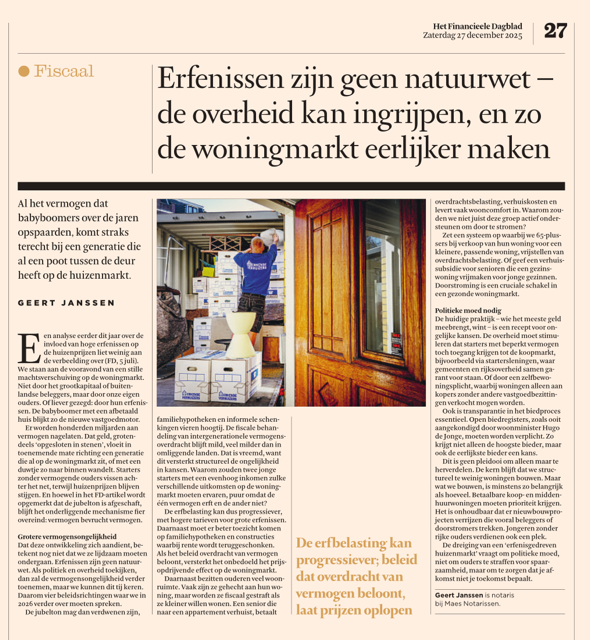
Inheritances are not a law of nature - the government can intervene and thus make the housing market fairer
All the wealth that baby boomers saved over the years will end up in the hands of a generation that already has a foot in the door in the housing market.

Opinions - Posted on
Four Pitfalls in Market Analysis, Recording & Investments and How to Avoid Them
A letter from MAES Notarissen appeared on Vastgoedjournaal about four common pitfalls in market analysis, listing, and investments. The article explains which risks are often underestimated and how to cleverly avoid them. A must-read for anyone who wants to make well-informed real estate decisions.

Opinions - Posted on
Student housing requires legal courage
The Dutch student housing market is creaking: while the student housing shortage is increasing, existing student houses are disappearing due to regulations and administrative reluctance. News site Advocatie published an opinion piece by our notary Geert Janssen exploring how current law does offer opportunities to alleviate the pressure.

Opinions - Posted on
New mixes in retail real estate
The Dutch retail real estate market is rapidly evolving. While shopping streets have struggled with vacancies and declining investments in recent years, new opportunities are now emerging. From mixed-use developments to sustainability improvements, retail properties are increasingly transforming into vibrant spaces where living, working, and shopping converge.
In a recent article on Vastgoedjournaal, Geert Janssen, a civil-law notary at MAES Notarissen, discusses these developments and the legal opportunities they present. Because anyone who wants to create value in this changing market must operate not only strategically but also with legal acumen.
In a recent article on Vastgoedjournaal, Geert Janssen, a civil-law notary at MAES Notarissen, discusses these developments and the legal opportunities they present. Because anyone who wants to create value in this changing market must operate not only strategically but also with legal acumen.
Services
See also

Why MAES notaries
We guide our clients through the moments that truly matter in life. Whether for business or pleasure. We offer peace of mind, reliability, and security. Impeccable, dedicated, and honest.

Corporate Social Responsibility
We recognize the responsibility we bear for our stakeholders: our customers, our employees, suppliers, the government, and the society we are part of. This applies to both our professional and social spheres. Our social responsibility focuses on three themes: governance , a sustainable living environment, and social engagement. We hope to make an impact through these initiatives.